What Are The Best Free Seo Tools For Beginners?

SEO, or search engine optimization, is a process by which website owners can improve their site’s visibility and ranking on search engine results pages (SERPs). While there are a number of ways to do SEO, many people find it helpful to use tools to assist them. There are a number of great free SEO tools available for beginners.

One such tool is Google Search Console. This tool provides users with information on how their website is performing in Google search results, as well as insights on how to improve their website’s visibility and ranking. Another great tool is MozBar. MozBar provides users with information on the authority and relevance of websites and pages. It also allows users to track their site’s progress in Google rankings over time.

7 Best Seo Tools For Beginners To Start SEO

There are a lot of great free SEO tools out there that can help beginners improve their rankings on search engines. These tools can help you research your competition, optimize your website, and track your progress. Here are seven of the best free SEO tools for beginners:

Google AdWords Keyword Planner

The Google AdWords Keyword Planner is a free tool that helps you find and research keywords to use in your AdWords campaigns. You can use the planner to get ideas for new keywords, see how popular a keyword is, and estimate how much traffic you could potentially get from targeting a particular keyword.

The planner also provides information on related keywords, such as the average monthly search volume and competition level for each keyword. This can be helpful when choosing which keywords to target in your campaign.

You can access the Google AdWords Keyword Planner by creating a free AdWords account.

Pagespeed Insight

Page speed is one of the many signals that Google uses to determine a website’s rank in search results. A fast-loading website provides a good user experience and can help your website rank higher in search engine results pages (SERPs).

To help you improve your website’s page speed, Google has created the PageSpeed Insights tool. This tool measures the page load time of your website and provides feedback on ways to improve it.

The PageSpeed Insights tool is free to use and easy to navigate. You can enter the URL of any webpage and get a report on that page’s performance. The report includes information on how well the page loads on both mobile and desktop devices, as well as suggestions for improving its performance.

VPN

SEO professionals recommend using VPN for a number of reasons. A VPN encrypts your traffic and routes it through an intermediary server, making it more difficult for someone to spy on your activities or steal your data. In addition, a VPN can help you get around geographic restrictions on content. For example, if you’re traveling outside the United States and want to watch a show that’s only available on Netflix US, you can use NordVPN or ExpressVPN to spoof your location and access the US version of Netflix. You can buy the NordVPN 3 year plan of NordVPN company to save your money on this best VPN.

VPNs are also useful for SEO purposes. They can help you bypass content filters and access blocked websites. They can also improve your search engine ranking by increasing the amount of traffic to your site. And best of all, VPN are free and easy to use.

Screaming Frog

The Screaming Frog SEO Spider is a desktop application that crawls websites’ links, images, CSS, script and apps to audit on-page SEO. It’s free to download and use for personal projects, with paid plans available for agencies and businesses.

The tool is used by digital marketers and SEOs to identify potential issues with a website that could impact its search engine visibility. The Screaming Frog SEO Spider can crawl up to 500 pages for free, or 5,000 pages for paid users.

Answer The Public

Answer The Public is a free SEO tool that uses Google Autocomplete to generate long-tail keyword ideas. Simply enter a keyword, and Answer The Public will generate a list of related questions and phrases.

Answer The Public is a great tool for finding long-tail keywords. It’s easy to use, and the results are accurate and up-to-date. Answer The Public also offers a paid version of their tool, which includes more features such as data export and SERP analysis.

Google Analytics

Google Analytics is a free online tool used to track website traffic. It provides data on website visits, pageviews, unique visitors, and other statistics. This information can be used to improve SEO and SEM efforts. Google Analytics is a powerful tool that can help businesses measure the effectiveness of their online marketing campaigns.

Proranktracker

If you’re looking for a great way to track your website’s search engine rankings, Proranktracker is the tool for you. It’s free to use and provides tons of valuable information about your site’s performance in search engines. You can track keywords, see how your site ranks for different queries, and even get alerted when your site moves up or down in the search results. Proranktracker is a must-have tool for any SEO or SEM campaign.

Which Is The Best Free Seo Tool For Beginners?

There are a number of SEO tools available online, both paid and free. When it comes to finding the best free SEO tool for beginners, there are a few things to consider. The first is the ease of use – the tool should be easy to navigate and understand. The second is the features offered – the tool should offer a variety of features that can help with optimizing a website for search engines. Finally, the third consideration is customer support – good customer support can be helpful when troubleshooting issues or getting help with using the tool’s features.

When considering these factors, two tools stand out as being the best free SEO tool for beginners: SEMrush and Moz. These two tools offer a variety of features that can help with optimizing a website for search engines, and they both have easy-to-use interfaces.

What Is The Best Cheapest Seo Tool For Beginners?

SEO tools come in all shapes and sizes, and can be used for a variety of purposes. When it comes to choosing the best SEO tool for beginners, it’s important to consider what you want to achieve with the tool, as well as your budget and technical ability.

One free SEO tool that is popular among beginners is Google Search Console. This tool provides users with information about their website’s visibility on Google search results pages, as well as insights into how users are interacting with their website. It also includes a range of tools to help you improve your website’s SEO performance.

Another popular beginner-friendly SEO tool is SEMrush. This tool offers a wide range of features, including competitor analysis, backlink monitoring, and site audits. It also has a limited free version which allows you to carry out some basic tasks such as keyword research and competitor analysis.

Author Bio: Hugo Baker is an online writer on a mission to promote safe connections all over the world. His area of expertise is VPN and technology. He has gained experience by writing and sharing his knowledge with others on various platforms.

6 Advanced SEO Tips & Tricks to Boost Website Traffic

What Is SEO and Why Is It Important?

SEO stands for search engine optimization. It is the process by which webmasters make their websites appear higher up on the SERPs to drive more traffic.

SEO is important in the current era due to the immense marketing potential of websites. Businesses and service providers alike have websites through which they try to increase their exposure. SEO is crucial to these parties since they have to make their website as popular as possible.

Normal methods of marketing are still viable, but online marketing is more or less essential nowadays. Hence SEO, by extension, can be considered indispensable as well.

Now that you know why SEO is important, let us take a look at some tips that can help you improve your site’s SEO.

6 SEO Tips and Tricks to Boost Website Traffic

SEO tips are always changing because search engines do not stick with the same algorithm for too long. The algorithms for ranking sites get updated every now and then. This makes it almost impossible to know what kind of SEO you need to do to rank high.

Google alone rolls out 500 to 600 updates annually.

However, some methods always show results and we are going to be going over some of them in order.

  1. Have a Good UI/UX for Your Website

UI/UX stands for “User Interface and User Experience”. You need to have a website that is easy and intuitive to use. People who visit your website must have a good user experience.

Too often it happens that users get confused when visiting a new site and they leave instead of exploring it further. This increases the ‘bounce rate’ of the site.

‘Bounces’ can also happen if a site is too slow to load. So, you will need to make sure that it loads very fast. This counts towards “User experience”.

If a site’s bounce rate is too high, search engines will think that it does not contain the content relevant to its target keyword. Subsequently, they will rank the website lower in the SERPs.

A well-designed website will decrease the bounce rate, thereby contributing to SEO.

  1. Target a Specific Niche

Your website should have a clear direction. It should not be a website that contains a random blend of different topics.

You need to have only one type of content on your site. For example, if you are a programmer, you will probably make a site that has tips for budding program, or posts about some new trick that you have found to utilize certain functions or libraries.

There is a catch, though. Programming is a huge field, and there are tons of programming languages out there with lots of frameworks and libraries. You cannot possibly target all of them.

Your site will need to be only about the specific language you are an expert in, and the various libraries and frameworks for it that you are skilled at.

By keeping things tight like this, search engines get a clear message what topic a particular site is about.

This helps them rank you higher for the correct keywords.

  1. Feature Quality Content

A website needs to have some good content on it. Content plays a major role in SEO.

Search engines check if websites are producing a steady stream of new and unduplicated content. If they are, their ranking in the SERPs increase (provided the content is relevant and of good quality).

If the content is found to be duplicated or written poorly, the ranking in the SERPs falls. Plagiarism in particular is very detrimental to SEO.

Search engines typically punish websites that have duplicated content by lowering their ranking or removing them from the listing altogether.

You can detect plagiarism in your content by using a free plagiarism checker. There are a lot of such tools available that can help you optimize your content.

  1. Meta Description and Page Titles

Your page title is the first thing that people will see when they find you on the search results page. That’s why it needs to be impactful and attention-grabbing.

Meta data i.e., Meta tags and Meta descriptions help to define the relevancy of your website to the search engine crawlers.

Adding a Meta description also helps people see what your site is offering while they are on the search results page.

This can attract people who are looking for what you offer. The Meta description gives a small but concise explanation of what the page is offering.

You have to make sure to use your target keyword in the Meta description. Another tip is to make the Meta description unique for each page. Remember to keep the Meta description under 160 characters.

  1. Make High-Quality Backlinks

For good SEO, you must have a good number of high-quality backlinks. This number is an important ranking factor that search engines consider when assigning a rank to a website.

To generate good backlinks, you need to reach out to other bloggers in your niche and ask them for collaboration or ask them to allow you to guest post.

You also need to go to various forums that are related to your niche and participate in questioning and answering.

This will put your name out in the open. Giving good answers can be an opportunity to link your site (as a reference for more detailed answers).

Once people start noticing you, they will be more inclined to link your articles on their sites, or in comment sections in response to other people.

One thing you need to take care of is to only reach out to sites that have high authority. Backlinks from high authority sites are more valuable and pass on more ‘link juice’…as the community likes to call it.

  1. Target Proper Keywords

Keywords are the life and soul of SEO. Targeting the correct keywords is essential. If your site is showing up for the wrong keywords, it will drastically increase the bounce rate.

That is because people are not looking for your site in the first place. After all, it is showing up for the wrong keywords.

Keywords can range from general to specific, and the more general they are the more volume they have. Conversely, they have a less specific search intent.

Targeting specific keywords might sound scary, as you are intentionally reducing traffic. However, targeting specific keywords helps the search engines realize the purpose of your website very clearly.

This will make the search engines place your site closer to the top whenever they detect the same intent from a search.

Conclusion

These were some tips for the SEO of your website. These tips will help you rank higher in the SERPs and make your website stand out from the competition. In 2022, optimizing websites for both humans and crawlers is very lucrative.

When a human has a good experience on your website, they may link it on other platforms and help you generate more organic traffic.

On the other hand, when bots/crawlers are easily able to discern what your site is about, it helps them index it correctly and match it to the correct search intent. This makes them rank your site higher in the SERPs.

With these tips, you will be well on your way to making your website rank high in the SERPs.

How the Live Stream Industry Impacted Web Design (for the Better)

Video content has significantly grown in popularity within the last few years. One of the primary reasons is that video technology has rapidly developed. In fact, video content has become so popular that research by Statista shows video viewership will increase to 248.9 million U.S. viewers in 2022.

However, out of all the video content available online, one of them has had the biggest impact — live streaming videos.

These days, more people are watching live streams. In 2021, live streaming estimated 548.7 billion hours of watch time. That impressively makes it one of the most popular forms of online content.

Because people enjoy live streaming content daily, it’s clear that the streaming industry will keep expanding. In fact, the live-streaming market reached $70 billion in 2021, and it continues to grow.

While live streaming has impacted the world, web design is one area that will have a mark.

How Live Streaming Impacted Web Design

In the live stream industry, there are several reasons why it has become so popular. One of them is that streamers can engage with thousands of viewers across the globe in real-time. During a live stream, creators get to communicate with people via live chat — making their streams highly interactive and intriguing to watch.

Additionally, live streaming is cost-efficient. Unlike broadcasting on TV, live streams are entirely free to run on the internet. Plus, they don’t require as much of an expense for production. With lots of savings and the ability to monetize live streaming, this increasingly attracts streamers and has helped many businesses worldwide.

Moreover, it has allowed people to stay connected while the lockdown orders proceeded during the pandemic.

However, streamers are starting to realize the opportunities that live streaming brings when it comes to monetization.

Creators Are Designing Their Own Live-Stream Platforms

Streamers rely heavily on some of the most popular live-streaming platforms, like YouTube, Facebook and Twitch. These networks allow live streamers to be successful with the billions of viewers that use these sites.

However, public networks have limitations — restricting monetization, enforcing strict content guidelines and limiting channel discoverability with the algorithms.

Now live-stream creators look for a place where they have complete control over their content. That’s where web design comes into play because more streamers require their own live-streaming websites. And they need special features to create a successful live-stream site.

Between the popularity of live-streaming and the realization of creating their own platform, web design will have a crucial role in the industry. With more live-stream creators turning to their own platform, they get to:

  • Have creative freedom.
  • Control their income.
  • Reach more people with SEO (search engine optimization).
  • Increase their brand awareness.

Essentially, it empowers you to take control of your live streaming business. That’s why more designers are creating websites for people to achieve their own success. But for you to reap the benefits of your own digital space, you have to incorporate certain web design elements.

Web Design Features Needed in a Live-Stream Website

Web design can help you establish your brand as an influencer or live–streamer. You’ll look more legitimate and professional to your fans, helping you create more opportunities.

However, web design is critical when creating a website. A good live-stream web design uses the right colors, fonts, words, images and graphics to appeal to users.

Here are some elements to consider incorporating when designing your live-stream website.

1. Create an Online Store

You generate as much revenue as you desire with your own website — more than what’s available on social platforms. If you plan on selling items during your live streams, you’ll need to host an online store, so people have a place to buy merchandise.

When designing your e-commerce store, try to keep it simple. The more pop-ups, banner ads and colors you add, the more it takes away the point of closing a sale. Your design should be clean, clear and simple so users can easily find what they want.

2. SEO-Friendly Website

When developing new web pages, you need to ensure you optimize your site with clean, SEO-friendly code. Incorporating SEO into your site allows your streaming brand to appear in Google’s search results. As a result, you show all of your brand’s entire offerings.

Take time creating your site’s code to increase your return on investment. SEO-friendly coding will guide search engine spiders and provide them with a clear picture of your website’s content.

Furthermore, it helps to design a blog page to drive traffic to your website. If you create a blog section, you can target your audience with keywords and answer your user’s with the most common questions.

3. Drive Brand Awareness

A professional-looking website can attract more fans to your live-stream platform. To achieve better results, though, you need good branding. Branding awareness is crucial since it provides credibility in a saturated market and can set you apart from other live-streamers.

To design a brand successfully, you’ll first need to create a brand strategy that defines who you are in your business. Then, you can start incorporating your branding into your live-stream website.

For instance, colors are an essential part of branding. They can stimulate different emotions and associate with other characteristics.

When choosing the right color palette, consider its effects on the human mind. Doing so will help you determine which ones are the right fit for your brand. Once you pick the right colors, you’ll be able to create an attractive logo design and ensure your brand is memorable.

4. Create an Interactive and User-Friendly Experience

Finally, your website will need a user-friendly design. Users expect a lot these days when they interact with websites. Therefore, you need to create a live-streaming website that’s interactive and easy to use.

Some of the important features you’ll need to pay careful attention to when designing your streaming site will include:

  • User registration: Ensure you set up the proper sign-up forms, so users have access to your live streaming content. You can provide various formats for users to log in, including email, Facebook account and a mobile number.
  • Video search: Users will need a place where they can find your previously uploaded content. Consider categorizing your videos by topic, date, video length, genre, most-watched, etc.
  • Video player: For better user experience, provide the options of sharing and embedding videos. Offer related videos, playlist configuration, download buttons and video quality selectors for enhancements.
  • Payment Integration: If you plan on creating a subscription model for your live stream business, ensure you support online payments using third-party integrations.

Kickstart the Design of Your Live-Stream Website

It’s no wonder more streamers are turning to their own platforms. They get freedom and creativity doing it.

However, designing a new website considers usability, attractiveness and optimization. When incorporating live-stream into your web design, consider following the tips above to ensure you enhance the overall experience for your users.

Eleanor Hecks is editor-in-chief at Designerly Magazine. Eleanor was the creative director and occasional blog writer at a prominent digital marketing agency before becoming her own boss in 2018. She lives in Philadelphia with her husband and dog, Bear.

3 Tips for Successfully Expanding Your Business

Healthy business growth is a delicate balance. You want to ensure that your company is ready for growth and has the capacity to handle an increase in business without overextending yourself. If you’re considering expanding your business, here are five key factors to keep in mind.

1. Map Out Your Growth Plan

Every business expansion needs a strategy. You need to decide what you want your business to look like after its growth journey. There are a few paths you could take:

  • Expanding your product line. One of the simplest expansion models is to add new products or services to your existing lineup. This approach not only encourages customer retention but can also attract new business.
  • Opening new locations. Adding another location in Crestwood, KY can be a great way to increase your revenue. It’s also a step closer to franchising if that’s something you’re interested in down the road.
  • Increasing your capacity. If you’re already operating at or near capacity, expanding your production capabilities could be the way to go. 

No matter which path you choose, it’s important to have a plan in place. This will give you a roadmap to follow so you can keep your expansion on track.

2. Evaluate Your Existing Strategies and Processes

Once you have an end-game in mind, it’s time to take a step back and assess your current business model. Are your existing strategies and processes set up to support growth? If not, you’ll need to make some changes. This might mean automating processes, streamlining your supply chain, or investing in new technology.

A company’s website, for instance, can be a powerful tool for growth. You can use your website to automate sales, marketing, and customer service tasks. This frees up your team to focus on other areas of the business. Kentucky web design firm Design Web Louisville can help optimize your website for local SEO.

You might also need to revisit your invoicing strategy. As you scale, you might need to automate your invoicing process to save time. There are invoicing solutions that offer features like recurring billing and automatic payment reminders so you can get paid on time, every time. You can also use an invoice template to simplify your invoicing process. The best invoice template will allow you to customize colors, fonts, etc. to be consistent with your branding.

3. Expanding Your Team

Finally, you’ll need to consider your team. As your business grows, you’ll need more people to help you achieve your goals. But adding new team members isn’t as simple as posting a job listing. You need to make sure you’re hiring the right people for the right roles.

When expanding your team, think about the skills and experience you need to support your growth. Do you need salespeople? Customer service reps? Once you have a good idea of the roles you need to fill, you can start writing job descriptions.

Celebrate Your Growth

Taking your business to the next level is an exciting accomplishment. Celebrate the milestone and use it as motivation to keep pushing forward. You can release a press statement, update your website, or throw a party for your team. 

Reach out to Design Web Louisville and take your website to the next level.

6 SEO Trends That are Bound to Rule the Coming Decade

Optimizing and ranking your website pre-2010 era was pretty easy. You’d just have to follow simple steps like getting your website up, throwing in a bunch of keywords, writing a bit about the topic, and Voila! Google would start ranking your website on top.

However, that’s not the case anymore. Also, due to the internet revolution, the number of websites that compete with each other to rank higher exploded. Due to these reasons, it started getting difficult for search engines to crawl and index the massive database of the internet.

Today, the Google search index contains hundreds of billions of web pages and is well over 100,000,000 gigabytes. Thus, it needs a formidable way to evaluate and rank each page.

The evolution of Search Engine Optimization as seen in the last decade that ended with 2020 was, if described in one word, stellar.

Search Engines, especially Google have improved their quality and user experience by shifting their focus from keyword-oriented to quality-oriented results. And as the days pass by, SEO will keep getting evolved as and when new trends emerge.

Meanwhile, let’s see some of the SEO trends that are bound to rule the coming decade.

6 SEO Trends That Will Dominate the SERP Ranking for Coming Decade

1. Content Quality & User Intent

Yes, content quality has long been here and affects significantly on the SERP rankings. However, many websites haven’t adopted this as their SEO mantra. They are still focused on short-term SEO gains through building backlinks, optimizing technical SEO, or doing digital PR.

However, these are not suitable for long-term SEO gains. Also, due to the massive size of the database, the Google algorithm will only rank pages that offer remarkable quality on a consistent basis.

Websites creating generic content will have lower chances of ranking than the ones that publish unique, quality content on topics not covered by others previously.

One way to adopt this in your competitive content marketing strategy is by researching well for the user intent of your target audiences to scour unique topics. Now, organize and prioritize these notions by relevance and cover them one by one.

The quality content doesn’t necessarily have to be SEO-friendly but it must fulfill the users’ intent and their expectations. And if the industry leaders are to be believed, Google has long been working to detect the intent behind every search users make.

Thus, considering the value of content quality and user intent it encapsulates, this trend is bound to rule the coming years as a SERP ranking signal.

2. SEO Automation

From admin workflows to IT services and marketing, automation has proven its effectiveness. SEO practices such as website audits, competitor analysis, search intent detection, and many others have already been automated. And from 2022 onwards, it’ll become more widespread as more SEO professionals around the world increasingly adopt automation with open arms.

Driven by AI and machine learning, SEO automation can intelligently do technical audits to scour issues by content type. Also, many SEO experts utilize SEO automation as quality assurance for their SEO services.

Moreover, AI-powered automation tools monitor potential SEO issues in real-time and warn as soon as possible to eliminate and resolve them beforehand. The SEO automation trend is continually picking up the pace. And it has gone from ‘nice to have’ to necessary when dealing with larger and more complex sites.

3. Mobile & Page Experience

Not so recently, Google had announced the mobile-first indexing for the whole web. And recently, it has started implementing a page experience update that aims to rank sites with better user experience scores for both mobile and web.

Thanks to this update, the entirety of the mobile and web, from the discovery phase to engagement, everything will correlate and be in sync to offer the best possible page experience.

The ripple effects of mobile-first indexing and page experience updates will cause a massive re-organization in the SERP ranking that we all can witness in the coming years. Thus, brands should start preparing their website from the onwards to not lose any significant SERP rankings.

4. SERP Localization

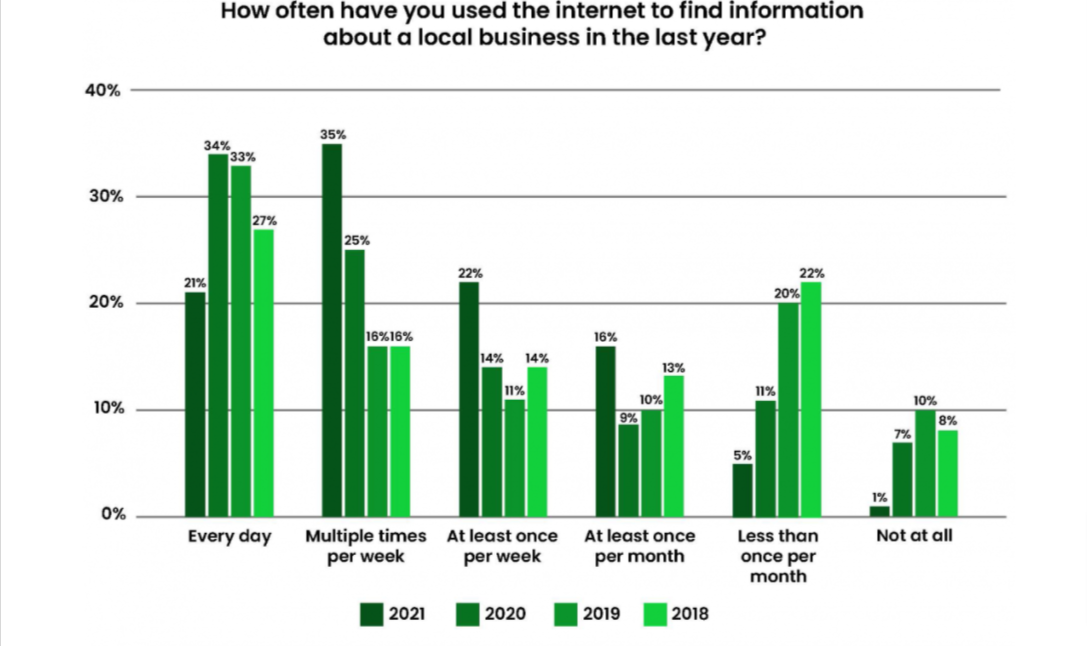
As per Brightlocal’s Consumer Survey, consumers that use Google for local business evaluation increased from 63% in 2020 to 81% in 2021. Also, the following graph shows that 21% of consumers use the internet every day to find information about local businesses and 99% have done so in the last year.

(Image Source)

From these statistics, we can idealize that Google will focus more on presenting localized content in the SERP results over the next few years. Already, the location-specific pages or content is outranking those who ranked at the top and focused more on global reach.

This will keep on picking up and become more obvious in the coming decade. Thus, websites with global target audiences will have to necessarily form a local presence to rank higher on localized SERP.

5. Metaverse Marketing

Metaverse marketing may seem like a new trend in the marketing sphere that’s thought to fade away with time. However, it has come a long way from being just another buzzword to a revolutionary strategy for marketers.

Metaverse can be conceptualized as the successor of the internet that we enjoy today. It brings the capabilities of the internet, virtual reality, and augmented reality together. As per Statista, there will be around a billion AR active users in 2022, which is supposed to cross the 1.7 billion mark in 2024.

Just like how brands optimize their web presence to get found on the current internet, they’ll have to find different ways to optimize their presence on the next generation of the internet i.e. Metaverse. A visual content strategy will play an important role in getting found on the Metaverse.

Audit your content strategy to find and optimize it with new content types and can implement AR, VR, and 3D experiences to leverage Metaverse marketing.

6. Voice & Visual Search

As mentioned in the previous point, visual as well as voice search will take precedence over the normal search approach.

As per one report, more than one-third of Americans use a voice search feature while 71% of consumers prefer making a voice search over typing. Another report projects that Google Smart Speaker Sales will hit 140 million in 2025.

This foreshadows that Google will prioritize the sites optimized for voice search and will feature them in the snippet results or show/speak when searched using smart assistants.

The same will apply for the visual search. After the introduction of Google Lens, the search engine giant is becoming better at interpreting SEO-optimized images day by day. The image recognition software will enable users to search for products and other things on the web.

Also, Google Discover uses images for tailored results. Thus, it’s predicted that normal search may start to resemble a lot more like Discover results filled with visuals.

Conclusion

Trends are known for their quick appeal when they appear first in the market. Many of those trends become obsolete after a certain period or when they are no longer relevant to the market. However, the above-mentioned SEO trends have been here for a few years now and we believe they’ll continue to be relevant in the coming years.

As more research and development are being conducted in the same direction, many of the trends listed in this article will go mainstream and rule the coming decade. Thus, brands need to sharpen their knowledge horns to drive sustainable and meaningful growth in the near future.

Author Bio

Hazel Raoult is a freelance marketing writer and works with PRmention. She has 6+ years of experience in writing about business, entrepreneurship, marketing, and all things SaaS. Hazel loves to split her time between writing, editing, and hanging out with her family.

How to Optimize Images for SEO

Search Engine Optimization is a critical part of designing a website. With a great SEO strategy, your website will attract organic traffic and position well on the search engine rankings. 

But do you know that there is more to a stellar SEO strategy than just working on the content? While they are often ignored, images also play an essential role in creating a sound SEO strategy. And leveraging the power of images and other visual content while designing your website’s SEO strategy will help you stay ahead of the competition.

This article talks about some excellent image optimization suggestions that you can use to increase your website’s speed and searchability.

Let’s get started!

  1. Resize Your Images

Image size refers to the resolution and dimensions of the images. The greater the resolution and the bigger the dimensions, the slower your page’s loading speed will be. And we already know that Google considers page speed while deciding SEO rankings. 

Here are some ways to ensure your images are the right size and don’t weigh your website down:

Choose The Correct Format!

Images are presumably the heaviest content on a page and add the most load to a website. Ultimately, this can lead to an increase in bounce rates and lower SEO rankings. By choosing the right format of images for different purposes on your website, you can achieve optimal loading speed. 

There are three primary formats for digital pictures: JPEG, PNG, and GIF. Each type uses a distinct compression method, which means the file size for these three types can differ astronomically. 

So, which type to use? Well, there is no one answer for this. 

For example, JPEGs take the least space and are great for photographic images. In contrast, PNGs are a good option for illustrations, screenshots, images with textual information, etc. One downside to PNGs is they are heavier in size, compared to JPEG. As for GIFs, they are suitable for animated images.

Decide Your Compression Rate

Compressing too much can lower the file size, but it will also impact your image quality. Whereas not compressing enough, your image file size will remain big. 

One of the best ways to compress a picture is through Photoshop. Select the ‘Save for Web’ option for a copy that is the ideal size and color for web use. TinyPnG, JPEG Optimizer, and many WordPress plugins are also helpful for this purpose.

  1. Never Use Sloppy Filenames For Your Images!

When it comes to image optimization, filenames are not to be taken lightly. 

Google has integrated a machine-learning image identification tool into its platform that can identify the content of the media file. But understanding an image is not always so easy. 

For example, if you have uploaded an image of a basketball-inspired birthday cake and simply named it “Image_101.jpeg“, chances are Google may identify it as a basketball only.

This is because Google is still a machine, and you have to help it as much as you can to comprehend what your image is all about. 

How? 

For starters, use a more descriptive filename. In this case, a better and more helpful name would be “basketball-birthday-cake.jpeg.” This name will help Google identify your image and rank it among birthday cakes and not basketballs.

  1. Don’t Underestimate The Power of a Good Alt Tag

Alt tags appear when the picture is unable to load on the browser for some reason. Search engine algorithms look for alternative tags to comprehend the image’s content and show them in place of the photo. 

The alt tags also allow people with visual difficulty better understand the picture when they are reading through a screen reader. 

Add precise alt tags along with your pictures. Aim to be as descriptive as possible by integrating relevant keywords in the alt tags. However, avoid keyword stuffing as Google can figure ‘over optimization’ and penalize your page for trying to trick their algorithms. 

Again, take the example of a basketball-inspired birthday cake and see what a lousy alt tag looks like and how you can make it better.

<img src= “basketball-birthday-cake.jpeg” alt= “basketball birthday cake birthday cakes happy birthday cake“/>

The above alt tag is an example of keyword stuffing. It also fails to explain what the image is actually about. 

To make the alt tag more readable, you should try something like:

<img src= “basketball-birthday-cake.jpeg” alt= “basketball-inspired birthday cake“/>

  1. Pick Unique Images For Your Website

Whether you choose to acquire images from an online source or click original ones, they mustn’t appear to be cliche. Just as textual content is supposed to be unique and not plagiarized for good SEO rankings, your visual content must also be novel. 

However, uniqueness can be an issue when using stock photos because they are readily available to almost everyone. What you can do to minimize the problem is add a hint of your own creativeness to them before you put them up on your website. 

Stock pictures are open for modification, so you are free to edit, crop, and even change the background to incorporate that tinge of uniqueness into the images. 

  1. Come up With Great Image Captions

Image captions don’t directly contribute to great SEO rankings, but they definitely improve the user experience on your website. Image captions are the writings that appear underneath your visual content. Unlike alt tags or image names, they are visible to the readers on your website. 

Putting a creative caption under your images gives users a complete feeling about the visual content. It tells them the purpose of the image, which they might not comprehend without the caption. Good image captions decrease your website’s bounce rate and boost your online reputation.

  1. Make an Image Site Map

According to Google, a sitemap is “a database where you give information about the pages, videos, and other files on your site and their relationships.”

While most webmasters add every textual information of their website on the site map, it is important to mention every visual asset on your website too. From the smallest thumbnail to the largest video – every element of your website should be part of the sitemap. 

It will help SEO spiders consider all the content on your website while deciding the rankings.

Conclusion

Search Engine Optimization is the present and the future of online marketing. And as said before, your SEO strategy will be incomplete without an excellent image optimization plan. 

Give these tips a try. We are sure they will increase your online credibility and rate you high in the SEO rankings. Good Luck!

Author Bio:

Ivy Attie is a content manager, researcher, and author in various media-oriented publications. She is a passionate communicator with a love for visual imagery and an inexhaustible thirst for knowledge. Her background is in communication and journalism, and she also loves literature and performing arts.

7 Ways Coding Can Help Your SEO

Nowadays, the world of digital marketing is a competitive battlefield. Like any battlefield, it’s crucial to be fully equipped, which means having a strategic content plan and effective marketing tools.

Indeed, content is king. However, some strategies must not be missed to ensure optimized search engine rankings. Coding is one of them.

For many webmasters, search engine optimization (SEO) is about boosting specific on-page variables to maximize the chances of being ranked for keywords or soliciting backlinks from qualified sources to strengthen off-page SEO. However, coding also plays a critical role in your site’s optimization. By harnessing coding for SEO, you are like building something on a robust foundation.

To help you understand why coding is essential when doing SEO, we’ll walk you through their relationship and how the former can boost your SEO. Let’s dive right in!

Does one need coding skills for SEO?

SEO doesn’t essentially require hands-on coding. But learning to code is a huge plus.

With coding skills and knowledge of technical SEO, one has a significant advantage in better optimizing a website and understanding technical issues that need addressing. A good understanding of SEO source code can also help a professional determine how to display a webpage content and peek at your competitors’ website source code.

To make the most of SEO practices, it’s crucial to have a good technical infrastructure, which includes programming. This programming is essential to optimize a site, especially for Google and cross-platform compatibility.

How coding helps SEO

SEO and coding are profoundly linked, thus providing benefits to each other. To know more about these benefits, let’s discuss how coding helps SEO.

1. Coding facilitates a seamless page experience for users

Page Experience involves a set of factors that measures how satisfactory it is for users to interact with a page beyond its pure information value.

Search engines like Google favor what works for the users better. So, with proper and well-written code, you ensure hassle-free webpage interaction. This means having a technical front that complements your user interface. With this, your website becomes more favorable for Google, thus resulting in improved search rankings.

2. Coding makes indexing easier for the web crawlers

Many say that SEO professionals must have even a little knowledge of HTML and CSS. This may be primarily because making changes to or improving the HTML tags, microdata, and website architecture, allow search engine algorithms to locate, understand, and rank the website faster.

3. Code validation allows for search engine spider accessibility

Search engine spider programs usually have serious limitations in terms of crawling and indexing your website. Given that they only effectively read text, other elements on your site—image, video, audio, and script files—can avert important site text from being crawled and indexed properly.

Should you notice that many parts of your text are missing from your web pages, if you have code validation skills, you can better cross-check if search engines can find your data.

4. Create SEF URL rewrites with coding

Making search-engine-friendly (SEF) URLs, which you can rewrite with coding, is advantageous for both SEO and user experience. To reduce the number of inapposite characters and codes in your URL, you’ll have to modify your website’s codes. But this depends on the specific platform your site runs on. If your site uses WordPress or another content management system (CMS), you will have access to internal dashboards or plugins that will permit you to make important changes. When it comes to open source e-commerce platforms though, you may need to address your permalink structure within your hypertext access file.

5. Coding allows you to establish 301 redirects for proper PageRank flow

When it comes to setting up proper 301 redirects, From an SEO perspective, there are two coding situations to consider in terms of setting up effective 301 redirects. First, you utilize this code to notify search engines that both world wide web (www) and non-www URL versions should be treated equally. Second, should you ever move content within your website, you establish a 301 redirect to inform search engine spiders of the action. By doing so, you reduce the potential loss of PageRank that may occur when backlinks can no longer resolve to your previous URLs.

6. Accelerate loading times with combined code files

In recent times, site loading speed has been considered as a huge search engine ranking factor per Google’s stated desire to reward swift sites in the search results. Unfortunately, if your site is built using many different scripts for additional functionality purposes, loading all the various code files will significantly bring down your site’s performance. To minimize long loading times due to excess script demands, it’s best to combine these individual code sheets into a smaller number of files. This way, you also improve your site’s overall SEO.

7. Utilize “rel=canonical” to deal with duplicate content issues

You may have duplicate content issues if you use a CMS program like Magento, Joomla, or WordPress to build your site. Every time you generate a new post for your website, these systems may automatically create any or all of the following options:

  • Yoursite.com/post-name.html
  • Yoursite.com/category1/post-name.html
  • Yoursite.com/archive/date/post-name.html

Since these different URLs redirect to the same page, search engines may subject you to duplicate content filters within their platforms, especially if you don’t specify exactly how each URL should be regarded or treated. To instruct search engines to better handle your URLs, you can use the “rel=canonical” tag. You can add this feature to your website’s <head> section and tell the search engines to disregard, redirect, or index a specific page for the URL.

In a Nutshell

SEO and coding altogether may be a complex concept, but by considering the best practices and benefits above, you can effectively optimize your search engine rankings and achieve your marketing goals.

How To Make Your Images SEO-Friendly

Every business owner should define what strategy they’ll follow to promote their products among the users, engage more customers, and promote the website’s ranking on search engine rates. However, sometimes it can be challenging to choose an exact approach that will be effective for your venue.

Before finding a proper strategy, business owners go through trial and error in increasing their services’ brand awareness by trying various experiments and marketing techniques. Only after many attempts will they succeed in finding out what strategy fits your local business prosperity.

Link building as a key approach for personal brand enhancement

Link building and backlinks implementation are the most useful approaches to creating a great local network and boosting your SERP position. You shouldn’t underestimate the significance of link building and backlink profile creation; indeed, it can bring a high ranking on Google and increase your clients. So, if you want to get a spot among the top tens, consider link-building efficiency.

If you don’t know how to launch a campaign for local link building, entrust this process to SEO geeks who will promote your website authority and engage more potential clients. Using an efficient tool for link building for a local business called linksmanagement.com, a website owner will receive a strong backlink profile with relevant links from credible sources that will bring even more users locally and worldwide. So, it’ll result in leads and sales increase.

LinksManagement is a good platform for effective link building for local businesses. Getting high SERP for your website means receiving more organic traffic and clients. Also, don’t forget that when dealing with local link building, consider your geolocation for more details and enable Google to define it correctly. Such a technique aims to engage more users and profit.

Creating a competitive and client-oriented brand is an effective way to outshine opponents in the niche. But, to do it smoothly, an entrepreneur should know well what steps to follow to be a leader in their area. The key point is to know your target audience, its needs, interests, and what information people expect to get from your source.

To succeed in personal brand creation, you need to carefully study your audience, your niche’s peculiarities, and nuances. You need to clarify what you can offer your client and surpass competitors. To promote your brand recognition, it’s crucial to work on your product appearance. You also need edited photos to make your brand memorable and outstanding.

Search Engine Optimization for Images: What Methods to Use to Increase Your Visibility


To climb up Google ranking, you need to arrange a solid SEO strategy. To catch the audience’s trust is also crucial to optimize images for SEO that will inevitably get more views for your source. So, each brand owner and marketer should know which tips to adhere to to make SEO-friendly images:

  • Name images properly to separate their naming via keywords with hyphens.
  • Apply consistent alt text that will provide a description for images.
  • Use captions to provide relevant information to the image.
  • Lower the used images’ size to make loading time fast.
  • Index your images by adding them to XML sitemaps.
  • Apply standard image resolution that is 72dpi.
  • Add images relevant to an article.

So, don’t neglect each aspect of image SE optimization to make your content more catchy, informative, and accessible to a broader audience. Learn how to improve images to speed up page loading and ranking. Image SEO optimization brings considerable benefits to your website promotion, such as enhancing users’ activity and rapid page loading time, resulting in superb ranking.

To make your SEO image strategy work, it’ll never be over to apply clear SEO best strategies in 2022. They’ll prove your professionalism in generating high-quality content making it user-centered and attractive to social media algorithms. This standard, but highly efficient practices will bring you profit and the audience’s interest:

  • Stellar content with trusted backlinks.
  • Choosing proper keywords and phrases.
  • Avoid click-baiting to boost your ranking.
  • Getting backlinks using white hat SEO principles.
  • Creating unique articles referring to credible sources.

By sticking to the above-mentioned careful SEO techniques, you’ll gain a positive reputation without using blackhat SEO and images copying without modifying them at all. Instead, implement proper keywords, include them smoothly in articles metadata, and place captivating images to increase a complete, useful, and well-optimized website.

The Ultimate Guide to Creating Location Pages

Local customers make up the largest portion of many businesses’ revenue. They’ll send new leads your way, leave excellent reviews, and share their experience with family and friends. Local SEO can send the right audience to your pages at the perfect time.

Internet Live Stats reports approximately 1.9 billion websites in 2022, but not all are active simultaneously. Even if you reach a broader audience than just those in the same location as your headquarters, you’ll want location pages so people can track your news by their area.

For example, if you have several restaurants in the state, you can create a location page for each with a map, store hours and other details. Location pages help your site rank for keywords, such as Indianapolis, Indiana, or New York City.

How can you ensure your location pages rank high in search engines and attract local traffic? Here is the ultimate guide to making sure you speak to browsers in the language they understand.

1. List Hours of Operation

One key reason people look for a particular location is to learn when it’s open. If you have multiple locations, you can list them on a single page along with an address and store hours. If you’re experiencing any interruptions in opening, include details so people don’t drive out of their way to get to your business only to find it closed.

Source: https://roosterswings.com/locations/view-all-locations

Roosters has multiple restaurant locations listed on its page. Each boc includes details such as location, address, store hours and directions to the dining establishment. Currently, there is a note on most listings about online ordering. You can add any details that might pertain to local changes and availability as it applies to your business.

2. Place NAP Details First

NAP stands for name, address and phone number. Ideally, you’ll include this information at the top of your page, so it’s the first thing people see. Search engines often utilize NAP details to understand where best to place your site in search results. If you’re located in a specific county and users search there for a service such as yours, they’ll raise your rank significantly.

Some experts advise building a separate page for each location. You can test both ways and see how it impacts search engine results pages (SERPs). If you choose to list all sites on one page, you should separate them in some way like Roosters did, such as in grid-style boxes.

3. Tell a Story

Who doesn’t love a good tale? You can easily place one on your location page while including information to help customers decide if you’re the right choice for them. A story might explain what you do, how the company started or why you serve specific locations. It must also include local factors and utilize keywords and phrases that make sense for ranking.

Source: https://www.chardonlabs.com/locations/kentucky

Chardon Laboratories offers water services in 13 different states. It provides location pages for each state and shares a little about the traditions in the area. Each page includes the popular industries for each state and some of the more significant manufacturers.

4. Choose the Right Keywords

Each location has specific keywords that trigger geolocation results. In Des Moines, Iowa, you might use phrases like “restaurants in Des Moines.” A car repair shop in Indianapolis might use “car repair Indianapolis,” “car repair circle city” and so on.

Make sure you include target keywords such as restaurant, dining and food in addition to being location-specific. The key is to grab traffic and bring it to your pages.

5. Get Location-Specific With Content

Adding content to your site gets you noticed and gives you something to share on social media platforms. Rather than writing about how to plan a wedding, you might share venues in your town, for example.

Other businesses might cater to activities in the area or services only people in a certain climate or terrain would need.

Source: https://aceraft.com/blog

Ace Adventure Resort offers different activities in the New River Gorge area in Fayette County, West Virginia. People looking for activities in the area will often search for terms used on its blog. All articles are about local events, so users may stumble on the page and find other details that interest them.

6. Add Reviews

Google and many other browser algorithms favor newer content. Reviews give you some user-generated content and offer a way to frequently update your location page with fresh material so the page pulls up in SERPs more often.

You might add a review or two under the NAP. You could also write something like “Have you been to this location? Give us a quick review” to encourage additional feedback and material for local SEO.

Ask Your Customers What They Want

The internet changes rapidly, so what works for location pages this year may not in the next. Be open to trying new things and testing your pages to see how ranking changes and what your users respond best to. Ask your customers what they want and what is most helpful for a location page. Over time, you’ll refine your offers and come up with a site that works with local SEO and is user-friendly.

Which Links Are Best Not to Use for SEO

SEO Links Every Website Owner Should Avoid

The success of your marketing campaigns depends on the quality of your SEO site links. From internal tags to inbound and SEO outbound links, link-building benefits your business in many ways. For starters, it increases your credibility to boost traffic and SEO scores. It also increases the value to readers, grows revenue from SEO affiliate links, and reduces bounce rates. However, not all SEO links are good for your website. Some attract search engine penalties and affect your rankings. Here are some SEO links that the best dating sites avoid.

typewriter

Press Release SEO Links

Press release SEO links were once popular because they were easy to get. After publishing a press release, all you needed to do was syndicate it to distribution websites and get numerous SEO links.

However, website owners abused press release links, pushing Google to consider a link scheme method. This is especially true for SEO links that target the main keyword with over-optimized text. To be safe from Google penalties, ensure your press release SEO links don’t pass PageRank. The best alternative is adding nofollow to press release tags.

Blog Comments

As long as you use them cautiously, blog comment links aren’t entirely discouraged. You can get natural traffic when you offer helpful advice redirecting readers to a blog. However, search engines will detect keyword-stuffed SEO tags going to one site.

The same applies to chat forum spam. It’s not uncommon for users to stuff their discussion forum signatures with links. These schemes are common across different platforms, from social boards to niche websites. Remember, you can still earn readers’ trust by having constructive discussions on the comment section without manipulation moves.

Substandard Guest Posts

Some website owners write low-quality guest posts to boost their ratings with backlinks. Google can disregard guest posts if they don’t provide value to readers or your marketing campaign. Search engines are also against too many guest post backlinks since they manipulate algorithms.

The key to escaping Google’s wrath is avoiding rich anchor texts in your guest posts. Remember to use anchor text variations. Using only one keyword format puts you under the radar of search engines.

Free stock photo of letter, SEO, SEO audit

Unrelated Niches

The best SEO backlinks come from sites in your industry. For example, you can link to travel blogs if you write restaurant reviews. Think of backlinks as academic citations; you need an expert to verify the information on your website. Moreover, aim for high-authority backlinks. Readers may lose trust in your brand if the linked site:

  • Is new;
  • Has low traffic;
  • Promotes clickbait;
  • Is biased.

One irrelevant backlink may go unnoticed by search engines, but using too many of them increases the risk of penalties. When most of your keywords come from other niches, search engines will use unrelated keywords instead of those that matter.

Don’t Force It

Your SEO anchor links should occur naturally. If you have a bad feeling about them, chances are search engines won’t understand them either. How do you improve your site with SEO backlinks? Share some strategies in the comments.

Authors bio

Rebecca Shinn is a freelance writer and dating and relationship expert with a psychology degree. Her field of expertise is relationship, dating, and marriage. The important part of Rebecca’s practice is to help couples with communication skills, problem-solving skills, stress management, and financial skills. 

Rebecca started writing 2 years ago to inspire and help people to have a better dating life, healthy relationships, or find a way to keep a marriage strong for long years.

With all said above, Rebecca is proud to be a mother and a wife so she doesn’t only use her knowledge for helping others but keeping her family strong and happy.